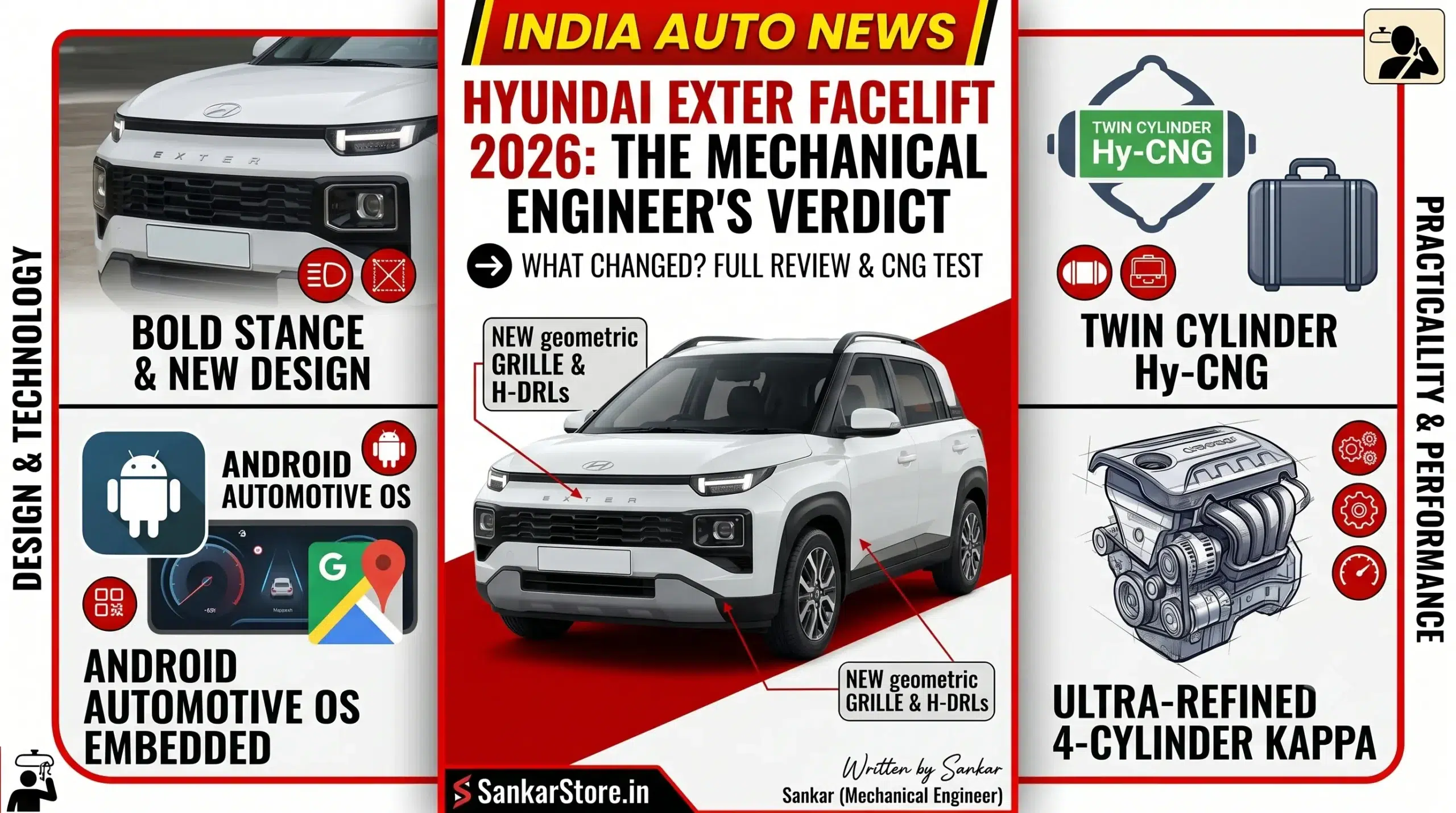
Hello, urban explorers and gearheads! Welcome back to SankarStore.in. I am Sankar, and as a mechanical engineer, I take a purely practical, no-nonsense look at cars based on real-world engineering metrics—not just the glossy promotional brochures handed out at authorized dealerships.
In the under-₹10 Lakh segment in India, micro-SUVs are an absolute goldmine. When it first launched, this specific car broke sales records. However, a recent market drop pushed the brand to introduce a major refresh. This car was built with one clear mission: to challenge the reigning segment king, the Tata Punch, and claw back its market share. This vehicle is none other than the new Hyundai Exter Facelift 2026.
Let’s dive straight into the engineering facts, evaluate what has actually changed, and determine if it deserves your hard-earned money.
Table of Contents
Dimensions and Architecture
From a structural standpoint, the platform belongs to the sub-4-meter vehicle category. It maintains its upright, boxy footprint, which maximizes entry and exit ergonomics while providing class-leading headroom.
🚗 Join the SankarStore AutoHub!
Don't miss out on the latest auto updates, price hikes, and real-world engineering reviews. Join our community for instant alerts!
- Overall Length: 3.8 Meters (3,830 mm)
- Wheelbase: 2.45 Meters (2,450 mm)
- Overall Height: 1.6 Meters (1,643 mm)
- Fuel Tank Capacity: 37 Liters
Exterior Styling Upgrades: Bold Stance & Aerodynamics
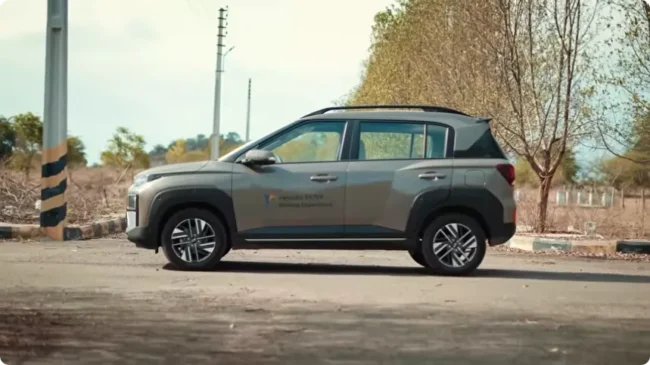
To improve its overall street presence across the country, several key cosmetic overhauls have been applied to the exterior sheet metal.
- Revised Front Fascia: The most prominent front update is the bumper assembly. The brand completely replaced the old grille setup with a wider, geometric radiator grille.
- H-Shaped Lighting Identity: It retains its signature “H-shaped” LED daytime running lights (DRLs) that tightly integrate into the turn indicators, alongside dual-LED projector headlamps. Given this is a budget segment vehicle, you won’t find front parking sensors or a front camera here.
- Premium Side Profile: On higher trims, the arches are filled by newly designed, high-contrast 15-inch dual-tone diamond-cut alloy wheels wearing 170/65 R15 tires. Mid variants receive standard 15-inch steel wheels, while the base models scale down to R14 profiles.
- Sporty Rear Overhaul: The back profile gains a completely new wing-type roof spoiler, a sharp shark-fin antenna, a rear defogger, an integrated washer/wiper unit, and a bold lower rear bumper layout flanked by two parking sensors and a reverse camera.
Cabin Tech, Storage, and Rear Passenger Space
The real-world value of this refresh unfolds the second you step inside. The brand listened to passenger feedback and rolled out practical cabin layout changes.
1. Driver Comfort and Tech Integration
The dashboard features hard, robust plastics, but the passenger side is styled with a distinct premium texturing to reduce sunlight glare.


- Factory-Fitted Dashcam: A major standout is the integrated dual-camera dashcam with a built-in display screen. This vital security and insurance feature comes standard starting from the HX6 variant.
- Sporty Mechanical Accents: For a performance-inspired feel under your feet, the cabin features first-in-segment metal pedals. You also get a flat-bottom, leather-wrapped D-cut steering wheel with blue contrast stitching. The brand intentionally retained the classic chrome ‘H’ badge on the wheel hub instead of shifting to minimalist dots.
- Ergonomic Enhancements: Long-distance highway travel is now significantly easier thanks to a new folding driver’s armrest attached to the manually adjustable driver’s seat.
- Infotainment & Cluster Display: The car packs an 8-inch touchscreen infotainment display supporting Android Auto, Apple CarPlay, and BlueLink connected car tech. It adds an updated Audio-Video Navigation system with clean 3D map visuals. The instrument cluster is fully digital, now housing a customized Tire Pressure Monitoring System (TPMS) display.
2. Rear Seating Comfort & Utility
The cabin layout uses a clean grey fabric theme for the seats. While comfortable and supportive, keep in mind that fabric stains faster than leatherette, so seat covers are highly recommended.

- The rear bench features adjustable headrests for the side passengers, though the middle passenger misses out on a headrest.
- For passengers taller than 5’11”, rear headroom can feel a bit snug due to the sloping roofliner.
- There is a slight floor hump in the center, meaning the middle occupant will have to stretch their legs slightly to the sides. However, rear passengers get dedicated AC vents and a fast-charging Type-C USB port right beneath them.
- Storage Packaging: Each door panel holds a 1-liter water bottle easily. The sound system relies on a generic 4-speaker layout, which sounds decent for daily commuting. The dashboard is completed by a cooled glovebox with a small storage shelf carved right above it.
Mechanical Layout: Smooth 4-Cylinder Engine Balance
Under the hood, the mechanical specifications remain unchanged. The vehicle relies on the highly dependable 1.2-Litre 4-cylinder naturally aspirated Kappa Petrol engine.
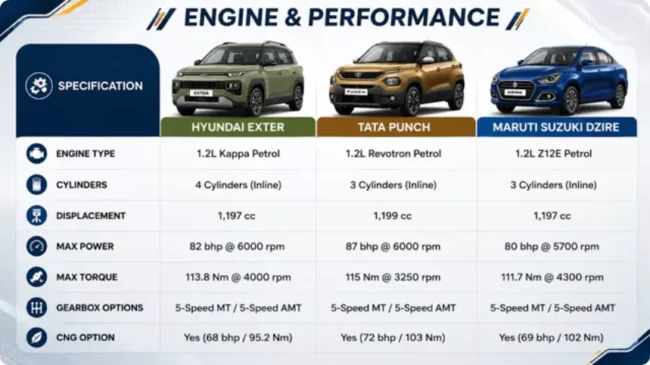
As a mechanical engineer, I must highlight that this 4-cylinder architecture is a massive advantage over its key competitor, the Tata Punch (which uses a 3-cylinder motor). 3-cylinder engines naturally suffer from unbalanced engine thrum and irritating idling vibrations felt through the steering wheel. Hyundai’s 4-cylinder Kappa engine is ultra-refined, virtually vibration-free, and dead silent at a stoplight.
Transmission Options: Manual vs AMT Automatic
The petrol powertrain can be configured with a 5-speed manual or a 5-speed AMT (Smart Auto) automatic gearbox with steering-mounted paddle shifters.
- The Mechanical Reality: The AMT automatic transmission suffers from noticeable gearshift lag. When attempting sudden overtaking maneuvers on single-lane highways, the computer takes a second to downshift, creating a distinct “rubber-band” delay.
- My Recommendation: If you love driving or commute frequently on highways, stick to the 5-speed manual transmission for instant throttle response and crisp control.
The Hy-CNG Twin-Cylinder Boot Space Solution
For car owners focusing entirely on low weekly running costs, the Hyundai Exter Facelift 2026 CNG variant is an engineering masterpiece in space optimization.

Standard single-cylinder CNG cars store one massive gas tank right in the trunk, completely destroying your luggage capacity. Hyundai bypassed this by using Twin-Cylinder Technology—installing two smaller, compact cylinders side-by-side beneath a false boot floor.
To keep the loading area flat and uniform, the engineers relocated the full-size spare wheel out of the cabin, mounting it flat on the exterior underbody of the car. This yields a massive, highly practical 391 Litres of base boot space (reduced to a highly functional volume on the CNG variant). You can easily pack full-sized family suitcases on top of the flat tank floor. If you need extra space, the rear seats fold down in a 60:40 split arrangement. In CNG mode, the power output drops slightly to 69 PS and 95 Nm of torque.

Fuel Efficiency (Real-World Mileage)
- Petrol Variant: The company claims an official fuel efficiency of around 19 kmpl. In heavy city stop-and-go bumper traffic, expect a realistic 13 to 14 kmpl. Highway cruising easily pushes that number up to 17+ kmpl.
- Hy-CNG Variant: If fuel costs are your primary concern, the CNG model returns an excellent economy of 27 km/kg, making it the ultimate budget commuter.
Safety Infrastructure: 6 Airbags Standard
While this micro-SUV provides a reassuringly tall driving view where you can see the edge of the hood clearly, it does have a distinct structural drawback: it currently holds no crash test safety rating from Global NCAP or Bharat NCAP. While the manufacturer anticipates a decent 3 to 4-star capability, the vehicle cannot match the certified 5-star structural safety score of the Tata Punch.

However, the active and passive safety features list is remarkably deep for this price point:
- 6 Airbags Standard across all variants (Front, Side, and Curtain arrays).
- ABS with EBD standard.
- Electronic Stability Control (ESC) standard from the base trim.
- Hill-Start Assist Control (HAC) standard from the base model, preventing the car from rolling backwards on steep mountain hairpins or steep parking ramps.
The Variant Overhaul & Pan-India Pricing
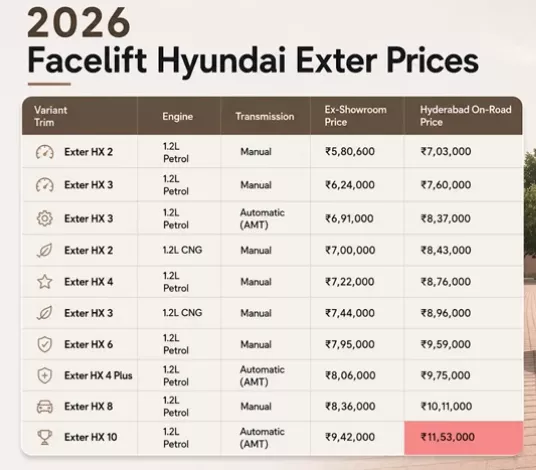
The manufacturer has completely renamed its entire variant lineup. The old names (like SX and SX Option) have been dropped for a streamlined HX nomenclature. The car is now available in seven distinct trims: HX 2 (Base), HX 3, HX 4, HX 4 Plus, HX 6, HX 8, and HX 10 (Top End).
- HX 2 Base Model (~₹7 Lakh On-Road): Skip this variant entirely. It lacks an infotainment display, speakers, and basic comfort creature comforts, making it feel too basic.
- HX 6 Value-for-Money Variant (~₹9.5 Lakh On-Road): This is the sweet spot of the entire lineup. It packs all the essential creature comforts, the factory dashcam, and smart styling bits without breaking the bank.
- HX 10 Top-End AMT Variant (~₹11.5 Lakh On-Road): This packs the dual-tone looks, diamond-cut alloys, single-touch sunroof, and paddle shifters for drivers wanting maximum premium features.
Sankar’s Real-World Verdict: Is It Worth Your Money?
The Hyundai Exter Facelift 2026 is a meticulously engineered urban commuter. It isn’t a rugged, off-road mud-plugger. Instead, it plays directly to what real families value: incredible cabin headroom, a highly polished 4-cylinder engine, segment-first safety tech standard from the ground up, and a highly practical trunk design on the CNG model. If you want a reliable micro-SUV that handles tight city lanes with ease, requires low maintenance, and feels premium inside, it is absolutely worth buying.
To see how this vehicle fits into the broader Indian automotive market this month alongside new fuel alternatives, do not miss my comprehensive national report: [Latest Automobile Updates in India: E85 Flex Fuel, 2026 Innova Crysta, & Tesla’s Grand Entry!].
What do you think about the new HX variant names and the twin-cylinder trunk space? Drop your questions in the comments below, and let’s talk about them from a mechanical perspective!
(Written by Sankar — Mechanical Engineer & Automotive Reviewer)

Frequently Asked Questions (FAQs)
What are the new variant names for the Hyundai Exter Facelift 2026?
The brand has fully transitioned to the HX series nomenclature. The micro-SUV is now sold across seven trim levels: HX 2 (Base model), HX 3, HX 4, HX 4 Plus, HX 6, HX 8, and the feature-packed HX 10 top-spec model.
How does the twin-cylinder CNG system work in the Exter Facelift?
Instead of placing one giant gas tank in the trunk, the engineers split the capacity into two smaller, compact cylinders tucked under a flat trunk board. By moving the spare tire out of the cabin onto the underbody frame, you get a flat loading floor that preserves space for actual suitcases.
Is the manual or the automatic transmission better in the new Exter?
The 1.2L 4-cylinder engine is exceptionally smooth. However, the 5-speed AMT automatic gearbox has a noticeable shift lag during quick acceleration. For the best driving engagement, throttle control, and seamless overtaking, the 5-speed manual transmission is the superior mechanical choice.
Join our community for honest car news, real reviews, and weekly auto updates — no noise, just facts.
Disclaimer: The information provided on SankarStore.in is for general informational purposes only. While every review is based on the real-world experience of a mechanical engineer, vehicle specifications, prices, and features are subject to change. Please verify all details with official dealerships before making a purchase. SankarStore.in is not liable for any damages, losses, or safety issues arising from the use of this information. Always drive safely and follow local traffic laws

COMMENTS