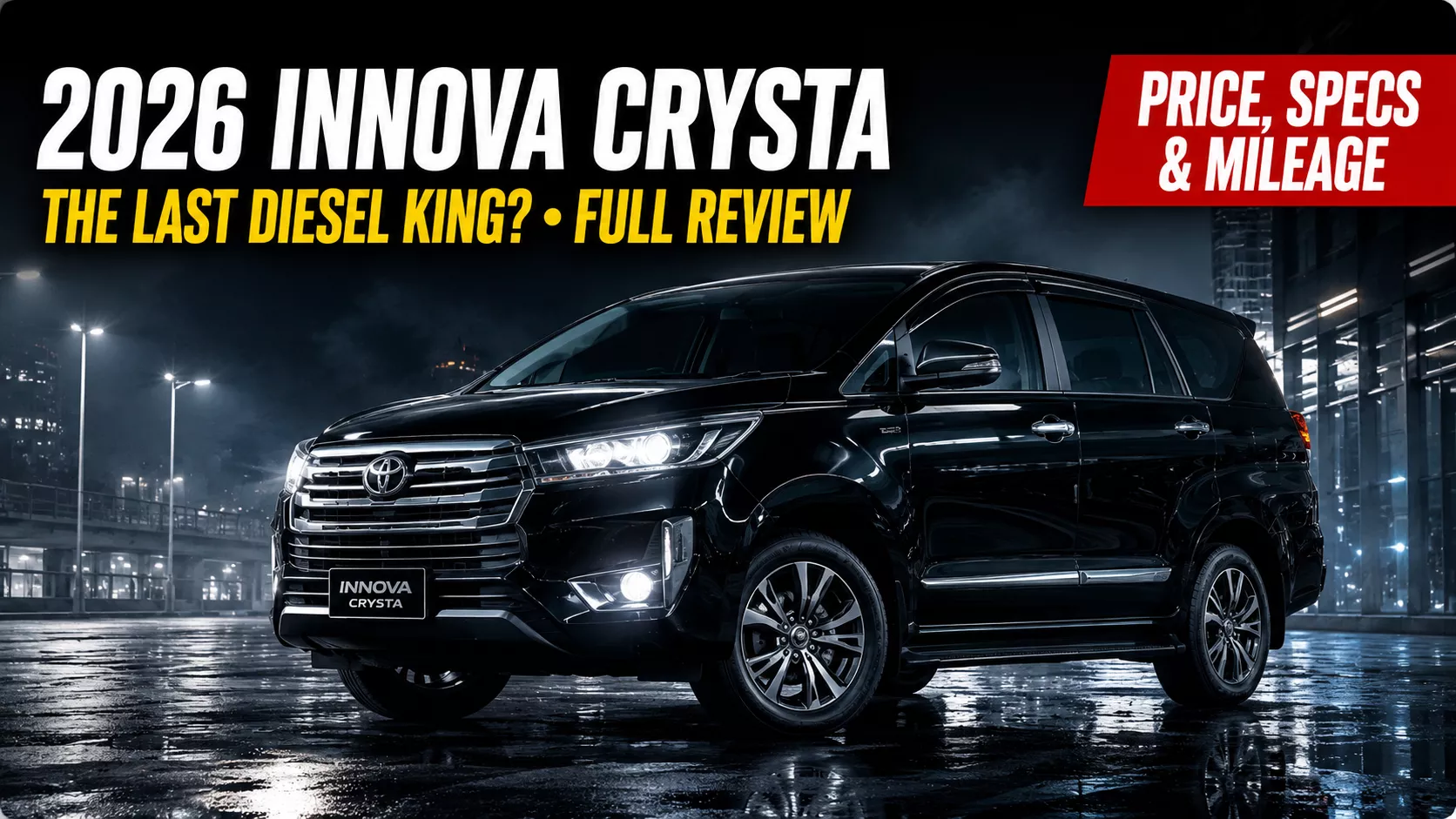
In India, the Toyota Innova is not just an MPV. It is an institution. Just like the Honda Activa is the default scooter for millions of households, the Innova is the undisputed king of long-distance family travel. Over my years as an automotive journalist, I have seen highly wealthy individuals who own supercars still keep an Innova Crysta in their garage for outstation trips.
However, the automotive landscape is changing. Toyota has shifted focus to the petrol-hybrid Innova Hycross. Rumors heavily suggest that the production of the legendary 2.4-litre diesel engine might end soon, making the 2026 Toyota Innova Crysta potentially one of the last batches of this bulletproof diesel workhorse.
As a mechanical engineer, I recently spent time testing a brand-new 2026 Innova Crysta GX+ variant (driven over 10,000 km in just five months by an owner). In this comprehensive buyer’s guide, we will break down the exact on-road pricing, real-world mileage, suspension comfort, and the harsh realities of driving a heavy ladder-frame MPV with hydraulic steering in modern city traffic.
Table of Contents
QUICK ANSWER: 2026 INNOVA CRYSTA HIGHLIGHTS
Here is what you need to know immediately if you are planning a purchase:
🚗 Join the SankarStore AutoHub!
Don't miss out on the latest auto updates, price hikes, and real-world engineering reviews. Join our community for instant alerts!
1. Only Available in Diesel Manual. Toyota does not offer an automatic gearbox for the Crysta anymore.
2. On-Road Price ranges from approximately ₹25 Lakhs (Base GX) to ₹34 Lakhs (Top ZX).
3. Real-World Mileage is exactly 13 to 14 kmpl on the highway and 9 to 10 kmpl in heavy city traffic.
Technical Specifications: The Mechanical Blueprint
| Specification | Toyota Innova Crysta (2026) |
|---|---|
| Engine Unit | 2.4-Litre (2393cc) 4-Cylinder Turbo Diesel |
| Maximum Power | 150 PS @ 3400 RPM |
| Peak Torque | 343 Nm @ 1400 – 2800 RPM |
| Transmission | 5-Speed Manual (RWD) |
| Dimensions (L x W x H) | 4735 mm x 1830 mm x 1795 mm |
| Wheelbase | 2750 mm |
| Ground Clearance | 178 mm |
| Fuel Tank & AdBlue | 55 Litres (Diesel) / ~11 Litres (AdBlue) |
| Boot Space | 300L (All rows up) / 1000L+ (Folded) |
| Tyre Size (GX / ZX) | 205/65 R16 (Base) / 215/55 R17 (Top) |
Engineering Analysis: Engine, Gearbox, and Driving Dynamics
If you are buying the toyota innova crysta 2026, you are buying it exclusively for the engine.
The 2.4L GD Series Diesel Engine
This 4-cylinder turbocharged diesel engine produces 150 PS and a massive 343 Nm of torque. As an engineer, the most important metric here is when that torque is delivered. The peak torque kicks in at just 1400 RPM.
This extreme low-end pulling power is exactly why the Innova effortlessly climbs steep mountain ghats even when fully loaded with seven passengers and heavy luggage. You do not need to constantly shift gears to keep the vehicle moving. It pulls strongly from idle.
There are two dedicated drive modes on the center console: ECO and POWER. Pressing the Power mode instantly sharpens throttle response. If you are cruising at 100 kmph on the highway and need to make a quick overtake, the Power mode provides a very noticeable, aggressive surge of acceleration.
The Highway Sweet Spot
During my testing on open stretches, the 5-speed manual gearbox feels perfectly geared for highway cruising. The absolute “sweet spot” for this vehicle is between 100 kmph and 120 kmph. In this zone, the cabin remains composed, engine noise is manageable, and the massive ladder-frame chassis simply glides over road imperfections.

The Problem: Hydraulic Steering in the City
This is the biggest downside of the Crysta. Unlike modern SUVs that use light Electronic Power Steering (EPS), the Innova Crysta still uses an old-school Hydraulic Steering System.
Driving this 4.7-meter-long vehicle in dense city traffic is exhausting. Making tight U-turns requires significant physical effort. If you are stepping out of a lightweight hatchback or a modern crossover, your arms will feel the strain of parking the Crysta.
Ride Quality, Suspension, and Body Roll
Ladder-frame vehicles are inherently top-heavy. While the suspension setup (Double Wishbone at the front and a 4-Link with Coil Spring at the rear) is tuned brilliantly for Indian roads, it behaves differently depending on your speed.
When you hit deep potholes or rough patches at a moderate speed, the suspension absorbs the impact incredibly well. The jolts do not transfer aggressively into the cabin. However, because of the tall stance and ladder-frame construction, there is noticeable body roll around sharp corners. Passengers will feel a sideways swaying motion if you take curves at high speeds.
Real-World Ownership: The GX Plus Variant Explained
To understand the actual buying process, I reviewed a brand-new black Crysta belonging to a subscriber, Mahiteja. He purchased the GX Plus 7-Seater variant in January for roughly ₹27 Lakhs on-road.
Why choose the GX Plus? The next variant up (the VX) costs nearly ₹4.5 Lakhs more. For budget-conscious buyers, spending that massive premium just for factory leather seats, an automatic climate control system, and a few exterior chrome bits does not make financial sense.
Instead, buyers purchase the GX or GX+ and spend around ₹1.5 Lakhs in the aftermarket. For example, the owner installed premium custom leather captain seats, heavy-duty floor mats, and Paint Protection Film (PPF), getting the luxury feel of the top model for a fraction of the cost.
Missing Features in Lower Variants
If you buy the base or mid variants, you must live with basic equipment:
- Manual air conditioning controls.
- Basic halogen headlamps (no LED projectors).
- No front parking sensors or factory 360-degree cameras.
- Hard plastics across the dashboard and door panels.
- Only 3 airbags (the top ZX gets 7 airbags).
- Standard key insertion (no push-button start).
Third-Row Comfort and Practicality
Unlike pseudo-7-seater SUVs (like the Toyota Fortuner or Tata Safari) where the third row is practically useless for adults, the Innova Crysta offers genuine space.

Accessing the third row is easy. Once seated, adults have adequate headroom and legroom (knees do not hit the front seats). However, there is zero under-thigh support. Your knees will point upwards. It is bearable for a 2-hour journey, but for long cross-country trips, the third row is strictly for children.
Boot Space Management
With all three rows up, you get 300 liters of boot space, enough for a few duffle bags. If you fold the third row (the seats fold up towards the side windows, they do not fold flat into the floor), the space increases to 528 liters. Folding the second row opens up a massive 1000+ liter cargo bay.
Real-World Mileage and Maintenance Costs
Toyota claims an ARAI-certified mileage of 15 to 16 kmpl. In the real world, heavily loaded with passengers, the innova crysta diesel mileage figures are:
- Highway Cruising (80 – 100 kmph): 13 to 14 kmpl.
- City Traffic: 9 to 10 kmpl.
Service Costs and AdBlue
Toyota’s maintenance is famously cheap. You can purchase the “Smiles Pack” from the dealership for approximately ₹18,000, which covers all labor and consumables for the first three major services.
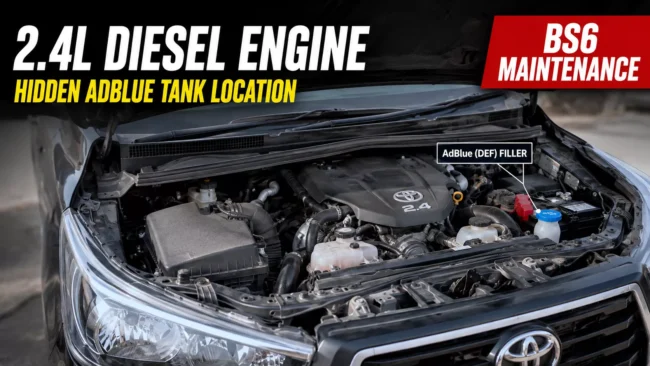
Because this is a BS6 Phase 2 diesel engine, you must refill the AdBlue (Diesel Exhaust Fluid). The tank holds roughly 11 liters, which costs around ₹1,000 and lasts for 6,000 to 7,000 kilometers depending on your driving style. The DPF (Diesel Particulate Filter) automatically regenerates as long as you maintain higher RPMs on the highway.
Pros and Cons: Should You Buy It?
⚖️ Toyota Innova Crysta Summary
PROS
- Indestructible 2.4L diesel engine built for lakhs of kilometers.
- Excellent low-end torque (343 Nm) for effortless overtaking with heavy loads.
- Incredible resale value (depreciation is minimal).
- Highly comfortable second-row captain seats for highway cruising.
CONS
- Heavy hydraulic steering makes city parking exhausting.
- No automatic transmission option available anymore.
- Outdated cabin with hard plastics and a basic infotainment screen.
- Third-row seats lack under-thigh support for adults.
Verdict: Innova Crysta vs Innova Hycross
The choice between the traditional Crysta and the new Hycross is remarkably simple.
If your daily running is primarily inside a congested city and you want the convenience of an automatic gearbox, soft steering, and high fuel efficiency (20+ kmpl), you must buy the Toyota Innova Hycross Hybrid.
However, if your native place is far away, you regularly travel across state borders with a family of five or more, and you need a robust, reliable workhorse that will not break down on bad roads, the 2026 Toyota Innova Crysta remains the absolute best vehicle you can buy in India for under ₹30 Lakhs.
Frequently Asked Questions (FAQs)
Is the Toyota Innova Crysta available in automatic in 2026?
No. Toyota has discontinued the automatic transmission for the Innova Crysta. It is now exclusively available with a 5-speed manual gearbox. If you want an automatic Innova, you must buy the petrol-hybrid Hycross.

What is the on-road price of the Innova Crysta 2026?
The on-road pricing varies by state taxes, but generally, the base GX variant costs around ₹25 Lakhs, the mid GX Plus costs ₹27 Lakhs, and the top-spec ZX variant touches ₹33 to ₹34 Lakhs.
What is the real-world mileage of the Innova Crysta 2.4 Diesel?
In real-world driving conditions, expect 9 to 10 kmpl in heavy city traffic and 13 to 14 kmpl on the highway when driven between 80 and 100 kmph.
Does the Innova Crysta have a sunroof or 360-degree camera?
No. The Innova Crysta is an old-school, utilitarian MPV. It does not offer modern features like a sunroof, 360-degree cameras, or ADAS.
How much boot space does the Innova Crysta have?
With all three rows of seats in use, it has 300 liters of boot space. By folding the third-row seats to the sides, the space expands to 528 liters.

COMMENTS